
Public Page

Follow


Joined on August 26, 2020

Trump deports Iranian asylum seekers!

Cartoon by Shahid Atiqullah

Second grup of Iranian nationals deported from US

Reuters: Fifty-five Iranians deported from the United States will return to their home country in the coming days, Iran’s foreign ministry said on Sunday, in the second such deportation under President Donald Trump’s immigration crackdown.

In September, officials said the US had identified about 400 Iranians to be deported, with a first flight carrying 120 people making its way to Tehran via Qatar’s capital.

“In the coming days, about 55 nationals will return to Iran...This is the second group being returned to Iran in the latest months,” Iranian foreign ministry spokesperson Esmaeil Baghaei said, adding that US deportations were based on “political grounds and anti-migrant policies that are against international law.”

The transfers mark an unusual moment of coordination between two nations at loggerheads over Iran’s nuclear program, which Tehran says is purely civilian but Washington asserts is aimed at building a nuclear bomb.

The two countries do not have a direct line of communication, Baghaei said, adding that they communicated through their respective interest protection offices or via intermediaries.

Baghaei also criticized Washington for not facilitating visas for all of Iran’s soccer delegation for the World Cup draw held on Friday in Washington.

“We have expressed our protest against the US’s decision not to give visas for our team dispatched to the World Cup draw,” Baghaei said.

While Iran had applied for nine visas for its delegation, Iranian soccer federation spokesman Amir Mehdi Alavi was quoted as saying that the US had granted only four visas, including for coach Ardeshir Amir Ghalenoei. The United States has long-standing strict visa restrictions on Iranians.

Deadly Pollution

Cartoon by ALIREZA PAKDEL

Smog Sends 210,000 Iranians to Emergency Rooms in Just 10 Days

STEVEN GANOT

The Medialine: Gray skies over Iran’s biggest cities sent more than 210,000 people with heart and breathing problems rushing to emergency rooms between Nov. 22 and Dec. 1, according to new government data that paint a stark picture of the country’s pollution crisis. The state-run IRNA news agency said patients flooded hospitals in several provinces as dirty air settled over Tehran and other urban centers.

The heaviest burden fell on Tehran, Khorasan Razavi, Khuzestan, and Alborz, where emergency wards saw surging numbers of people with chest pain, asthma attacks, and other complications. Jafar Miadfar, head of Iran’s Emergency Medical Services Organization, called the spike “a serious alarm for vulnerable groups and the public’s overall health,” warning that the trend will worsen if the smog persists. Older adults, children, and people with chronic conditions are considered most at risk.

To contain the damage, authorities have intermittently shut down schools and universities, shifted offices to remote work, and tightened traffic rules in the most polluted districts. Air quality index readings above 150—levels considered unhealthy for everyone—have been recorded repeatedly in recent days.

Iran’s smog problem is not new. Each winter, cold, still air locks pollutants over sprawling cities built around car traffic, refineries, and factories. Aging vehicles that burn low-quality fuel and decades of underinvestment in public transport feed the haze, while US sanctions have made it harder for Tehran to upgrade its energy and industrial infrastructure.

Health experts say repeated exposure to such conditions can shorten lives and drive up long-term rates of cancer, stroke, and cardiovascular disease. The latest emergency figures suggest that for many Iranians, the cost of stepping outside is no longer abstract—it is paid in hospital visits and labored breaths.

A.I. is not stupid

Cartoon by Marian Kamensky

Leave me alone, AI 

Pilita Clark

Financial Times: I can’t remember exactly when it started but some time in the last couple of months, AI went from being a topic of largely theoretical interest to an actively intrusive pest.

It began when a bluish purple circle appeared unbidden on my WhatsApp screen. I ignored it at first, thinking I had mistakenly swiped on something that had made it materialise and hoping that with luck it would go away. 

But one day, in a rush to message someone, I mistakenly tapped on the circle and discovered it was “Meta AI”, a chatbot eager to help me find a restaurant or a recipe or other things I never want to find on WhatsApp. 

Thankfully, it described itself as an “optional service” from Meta, the Mark Zuckerberg company that owns WhatsApp, Facebook and Instagram. Phew, I thought. I’ll get rid of it, since it’s optional and the last thing I need to be doing is handing over yet more personal data to help make Zuckerberg’s $200bn-plus fortune even larger.

But no. When I asked Meta AI how to delete Meta AI, I was told: “You can’t disable Meta AI, but engaging with it on WhatsApp is completely optional.” 

Jolted by this breathtaking piece of guff, I realised something else: any time I tried to send an email, write a document or do virtually any other type of online work, AI barged in and tried to do it for me. 

Composing a work email provoked the suggestion that I use Google’s Gemini AI to “help me write”, a tip that leaves me feeling the neurons shrivel as I read it.  

If I opened an online document, there was Gemini again, bleating at me to “summarise this file” or “catch me up” on developments that might have occurred — but almost never had — since I last looked at the thing.

Meanwhile, logging into my favourite online transcription service to read an interview has become more AI-infested by the week. 

I have grown accustomed to being urged to “ask AI anything about this conversation” each time I try to read a transcript, a task I am — oddly enough — quite able to do by myself.

This week, before I could even look at the transcript, I had to deal with a large pop-up informing me there was not one but two AI chat modes to choose from: express, which was “balanced for accuracy and speed”, and advanced, which was “enhanced for in-depth analysis”.

Since I only wanted to skim through a hopefully accurate transcript as quickly as possible, I had zero interest in either.

None of this would be so bad if AI were capable of doing something seriously useful, like whittling down my thousands of unread emails into a manageable list and, better yet, answering the most critical ones pronto. 

I have been enthused about the profusion of AI tools that now claim to be able to conquer inbox chaos, but every review I read about them makes me doubt their utility.

Of course they may improve and I admit some AI innovations are not bad, like the story summaries that several news groups, including the FT, have started to offer. 

I can also imagine times it might be helpful to be able to rip through all the transcripts of, say, one’s last five executive meetings to check what one’s boss said about the latest revenue targets. 

And I have to concede I may be in a minority. Meta AI has more than 1bn monthly users across all its apps, I discovered, when I messaged Meta to ask if it thought it was deceptive to call an undeletable chatbot optional. Unsurprisingly, it did not, pointing out that Meta AI was no different to other new WhatsApp features, such as camera effects, that people could take or leave — but not erase.

Also, a spokesman told me, none of the conversations people have with the chatbot on WhatsApp are used to train Meta’s AI models.

And although these interactions can be used to “personalise experiences” on platforms such as Facebook from mid-December, it will require people to add their WhatsApp account to a Meta accounts centre that includes Facebook.

Considering how fast changing this stuff is, I live in hope that today’s tedious intrusions will soon fade as people adapt to it. In the meantime I would be thrilled if AI would do one thing: go away and let me get on with whatever I was doing before it interrupted.

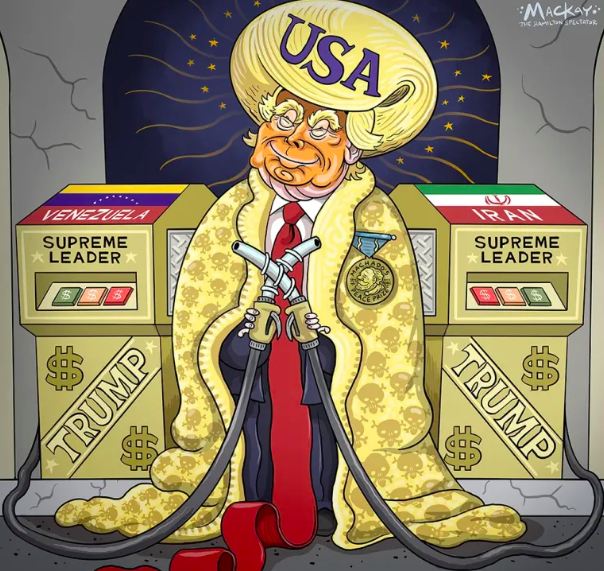
Venezuela

Cartoon by Markus Grolik

Colombia’s president warns Trump: ‘Do not wake the jaguar’ with threats of military strikes

Tiago Rogero, South America correspondent

The Guardian: Colombia’s president has warned Donald Trump that he risked “waking the jaguar” after the US leader suggested that any country he believed was making illegal drugs destined for the US was liable to a military attack.

During a cabinet meeting on Tuesday, the US president said that military strikes on land targets inside Venezuela would “start very soon”. Trump also warned that any country producing narcotics was a potential target, singling out Colombia, which has long been a close ally in Washington’s “war on drugs”.

Shortly afterwards, Colombia’s president, Gustavo Petro, hit back in a social media post, saying: “To threaten our sovereignty is to declare war; do not damage two centuries of diplomatic relations.”

Petro also invited Trump to visit Colombia – the world’s largest producer of cocaine – to see his government’s efforts to destroy drug-producing labs. “Come with me, and I’ll show you how they are destroyed, one lab every 40 minutes,” he wrote.

Since August, the Trump administration has escalated tensions in Latin America to levels unseen since the 1989 invasion of Panama, under the pretext of anti-narcotics operations. The Pentagon has deployed a sizable naval force with nearly 15,000 troops on Venezuela’s doorstep in the Caribbean and killing more than 80 people in strikes on small boats alleged to be carrying drugs.

“We’re going to start doing those strikes on land, too,” said Trump on Tuesday.

“You know, the land is much easier, much easier. And we know the routes they take. We know everything about them. We know where they live. We know where the bad ones live, and we’re going to start that very soon too.

When asked whether the efforts would be limited to Venezuela, the US president said they would not.

“I hear Colombia, the country of Colombia, is making cocaine. They have cocaine manufacturing plants, OK? And then they sell us their cocaine. We appreciate that very much. But yeah, anybody that’s doing that and selling it into our country is subject to attack,” he said.

Longtime allies in the “war on drugs”, the US and Colombia have found their relationship fractured almost from the moment Trump took office for his second term.

Their first clash came as early as January, when Petro – a former guerrilla and Colombia’s first leftwing president – refused entry to American planes carrying deported Colombians, insisting that they be treated with dignity.

He later reversed that decision, but relations further deteriorated in September, when, after attending the United Nations general assembly, Petro joined a pro-Palestine protest in New York and urged US soldiers to disobey Trump’s orders to “attack humanity”. He has also been a fierce critic of the airstrikes on the alleged drug boats.

Trumpspeak

Cartoon by Buna Alkhas

Trump targets Gov. Walz with slur, attacks Rep. Omar and Minnesota's Somali community

By Anthony Bettin

CBS News: In an invective posted to the Truth Social platform on Thanksgiving, President Trump used a slur for people with intellectual disabilities to describe Minnesota Gov. Tim Walz.

Mr. Trump also used racially and religiously prejudiced language against Rep. Ilhan Omar and said Somali refugees are "completely taking over the once great State of Minnesota."

Walz responded to Mr. Trump's insult on X, saying only, "Release the MRI results" — a reference to Mr. Trump's comments last month that he had an MRI during a recent checkup and received "perfect" results.

WCCO reached out to Walz's office for comment and was directed to the post above. WCCO has also asked Omar's office for a statement.

Walz unsuccessfully campaigned opposite Mr. Trump and Vice President JD Vance as Kamala Harris' running mate in the 2024 presidential election. 

On Thursday, Mr. Trump also ordered all green cards from Somalia and 18 other countries be reexamined. Days earlier, he said he would terminate temporary protected status for Somalis in Minnesota, claiming, without evidence, that "Somali gangs are terrorizing the people of that great state."

Somali leaders in the state, as well as Democratic lawmakers and advocates, have spoken out against Mr. Trump's attacks on the community.

Minnesota's Council on American-Islamic Relations on Friday called on Mr. Trump and "all political leaders" to "temper their language."

Minnesota has the largest Somali population in the U.S., roughly 80,000, according to Minnesota Compass, a project of Wilder Research.

Mr. Trump also said late Thursday night he would suspend immigration "from all Third World Countries to allow the U.S. system to fully recover." The president did not clarify when such a move might take effect or how the pause would be implemented. He also did not disclose which countries would fall under such a designation.

CBS News has reached out to the White House for clarification.

The latest escalation of the Trump administration's stance on immigration comes after an Afghan national allegedly shot two National Guard members in Washington, D.C., killing one of them and leaving the other critically wounded.

Iran, Persia, Islamic Repubic

Cartoon from social media

New statue of ancient Shah highlights Iran’s turn to pre-Islamic past

Amwaj: Iranian authorities have unveiled an imposing statue in Tehran depicting the ancient Persian King Shapur I on horseback, towering over kneeling Roman Emperor Valerian. The move is the latest attempt by the state to deploy pre-Islamic nationalist iconography to promote unity in the aftermath of the June war with Israel. But Iranians remain deeply divided; while some have praised the initiative, others deride it as a disingenuous display of patriotism.

The coverage: The massive installation was unveiled in Tehran’s Enqelab (Revolution) Square on Nov. 7, commemorating the Sasanian Empire’s third-century military victory against the Romans.

- The statue is part of a campaign entitled "You Will Kneel Before Iran Again," inspired by a statement from Supreme Leader Ayatollah Ali Khamenei.

- Tehran’s conservative mayor, Alireza Zakani, told reporters that the installation’s message is “the Iranian nation’s resistance and steadfastness throughout history.”

- State-affiliated media say thousands attended the ceremony to unveil the statue, which included performances by the Tehran Symphony Orchestra, several male pop singers and a light show. Notably, unveiled women were also allowed to attend the event—another break from usual state restrictions.

Some commentators welcomed the statue, describing it as a strong reminder of Iran’s ancient past.

- Political commentator Ehsan Movahedian, who is cited by both conservative and pro-reform media, said the move is “encouraging” and argued that the Islamic Republic “has finally realized its mistake in neglecting elements of Iran’s national identity.”

- Abdolmotahar Mohammadkhani, spokesman of the conservative-dominated Tehran City Council, hailed the attendance of the ceremony and asserted that “with the same national solidarity, the enemies will once again kneel before Iran.”

- Mehdi Shadkam, an Iranian studies researcher, praised the installation as “a commendable move in strengthening national identity” but faulted the craftsmanship—a criticism shared by others.

Meanwhile, others saw the installation as an example of the state’s misplaced priorities, characterizing it as an inorganic and politically calculated nationalist turn.

- Reformist commentator Ahmad Zeidabadi found the depiction of a kneeling Valerian distasteful, writing that it is “an image that, rather than inspiring pride, from the standpoint of Iranian national and religious ethics, symbolizes arrogance, conceit, and a kind of pettiness born of triumph over a rival.”

- Ehsan Bodaghi, a pro-reform journalist, said the statue “stands in contrast” to the Islamic Republic’s “45 years of persistent denial of the values of ancient Iran.” He added that if the initiative “is not a political exploitation of Iran’s history, then it is time to officially reconsider decisions such as the [current] content of history textbooks.”

- Maryam Shokrani, another pro-reform journalist, suggested that the statue’s unveiling was ironic, seeing as the authorities “ignore the threats” which cultural heritage sites face and cut the latter’s “meager” budgets.

Evolution of Weapons

Cartoon by Asier Sanz

Breaking the hypnotic spell of misinformation

The Globe and Mail: A video began circulating on Facebook shortly before the Irish presidential election in October. It was a report by the national broadcaster, RTÉ, with bombshell news.

Frontrunner candidate Catherine Connolly told a campaign event she was bowing out of the race. A crestfallen supporter shouted out “No, Catherine” before the clip cut to a reporter explaining what would come next. The election was off and her leading rival would be acclaimed.

A shocking development only days before the election. Except the whole thing was fake.

Ms. Connolly slammed the video as “a disgraceful attempt to mislead voters and undermine our democracy.” Meta eventually agreed to take it down and Ms. Connolly went on to win handily. But the video – which can still be seen, though is now branded clearly as being AI-generated – is an example of how dangerous false information can be.

Society can fight back against what has become a hypnotic stream of fakery. Society must. A world in which illusion, fraud and lies are the common currency becomes one in which there is no agreed-upon version of truth, undermining the very concept of reality.

Right around this moment it may be tempting for readers to think, well I’m not on social media, so I’m probably missing the worst of this garbage. Unfortunately, between the rise of generative AI and the viral power of bots, the trash has a way of seeping through to everyone.

Consider the artificial intelligence synopses that appear first when doing a web search. Data show that fewer and fewer people are scrolling down and clicking on links to find the answer they were seeking. But relying on the synopsis is risky given that AI uses the available information, and the source material is increasingly unsound.

The number of phony scientific papers is doubling every 18 months, posing real dangers when AI scrapes up false information and uses it in response to health queries.

A source of deliberately bad information is Russia, which seeds the internetwith propaganda specifically for the purposes of being picked up by AI. An ouroboros of digital deception.

Phony information can also percolate through society the old-fashioned way, passed from one person to the next. One group-chat to the next. And information of dubious origin, when coming from trusted friends or family, may be treated with less skepticism than it should >>>

Unfiltered Interent

Cartoon by Elham Azar

Iranian Lawmaker Admits Parliament Members Use Unfiltered Internet

IranWire: Iranian MP Ahmad Ardestani has confirmed that all members of parliament have access to unfiltered internet, following recent revelations that certain groups in Iran enjoy unrestricted connectivity.

“All parliament members have an unfiltered internet,” he said.

The lawmaker, who serves on the National Security Commission, also confirmed that “many organizations such as intelligence and security agencies” use so-called white SIM cards - direct internet connections that bypass government filters.

Ardestani attributed some lawmakers’ opposition to lifting internet filtering to their involvement in what he called the “VPN mafia.”

He said “many people want filtering to exist because they want to sell VPNs and do business.”

In a separate interview with Etemad newspaper, he said the VPN market has a high financial turnover and is controlled by “a mafia.”

A new feature on the social media platform X recently exposed that many government officials, political activists, journalists and media figures affiliated with the Islamic Republic - who previously claimed they accessed their accounts using VPNs - actually operate through unrestricted internet access known as “class-based internet” or “white SIM cards.”

The feature also revealed that several well-known accounts claiming to be opposition figures, and alleging affiliation with groups opposed to the Islamic Republic, were in fact being updated directly from inside Iran.

Putin's favorite puppet

Cartoon by Fadi Abou Hassan

The 28-point ‘peace plan’ for Ukraine may be dead – but Trump still won’t stop Putin

Dmytro Kuleba

The Guardian: Europe breathed a deep collective sigh of relief on Monday, as the crisis triggered by Washington’s presentation of a new 28-point plan for ending the war appeared – briefly – to have been stabilised. Marco Rubio, the US secretary of state, spoke of “substantial progress” after Ukraine-US talks in Geneva. On Monday night, Vladimir Putin made his countermove: another massive barrage of missile and drone strikes on Kyiv.

The sequence of contrasting events captured the grim essence of the outgoing year. By day, diplomatic battles are fought: hopeful statements are issued from Washington, London, Brussels and Kyiv. Immense energy is expended on containing Donald Trump’s initiatives. By night, Putin brutally reminds the world that, for him, war remains the primary tool for achieving “peace”.

As Russia’s attack unfolded into the early hours of Tuesday, the immediate reality of Ukraine’s vulnerability was laid bare. Ukraine is able to track missile launches from Russian territory, a capability afforded by timely US intelligence. Outside my window, two Ukrainian air force fighter jets, which had been scrambled to intercept incoming cruise missiles, roared overhead – American F-16s, supplied to Ukraine by one of its European allies.

Moments later, Kyiv’s air-defence systems thundered: two sharp launches fired to intercept a Russian ballistic missile. This was a Patriot system at work, most likely delivered by the US or Germany. Every launch jolts you unexpectedly, shaking the windows. The instant of fear quickly gives way to grim resignation: perhaps the incoming missile won’t strike its target this time, sparing the city from devastation and another blackout.

Soon after, a heavy machine gun opened up on a drone somewhere nearby, part of a mobile-fire group – almost certainly a US-made Browning. Unfortunately, the bullets missed the Iranian-made Shahed drone – it pressed on overhead, toward its destination.

With pauses, this continued until dawn. Kyiv awoke to the morning news: seven people killed, destruction and heating outages in many homes as a result of the night’s assault. As always, everyone still went about their day – living the war. But those 24 hours encapsulated Ukraine’s critical military reliance on the US – a dependence that Europe is demonstrably unable to fill in the short term.

The 28-point plan from Washington sparked intense emotion, debate and deep concern – and temporarily diverted attention from Ukraine’s largest corruption scandal in years. Yet, we have seen this script before, after that disastrous meeting between Trump and Zelenskyy in the Oval Office in February, and after the Alaska summit in August.

Every new initiative from Washington unfolds according to the same pattern: a diplomatic cavalry charge against Ukraine, which Kyiv, with other European capitals, manages to fend off. They stabilise the situation but never actually win the battle. This pattern will, no doubt, persist.

It is tempting to accuse Trump of consistently pushing Russia’s terms. But that does not seem to be the whole story. Washington operates on a premise well known to American diplomats: you cannot win at the negotiating table what you have lost on the battlefield. The White House presumes that it is impossible to force Russia to relinquish the territory that it already controls in Ukraine’s south or east.

The problem is that while recognising this factual reality, Washington does nothing to deter Moscow, through words or deeds, from thinking that the situation will shift further in its favour in the coming year.

Therefore, Putin is convinced that time is on his side – that Ukraine and its partners are approaching exhaustion. His motivation to sign a deal that does not give him the maximum possible gain is close to zero. There may be many attempts to end hostilities, but they will continue as long as Russia’s leader remains supremely confident in the outcome.

On the contrary, Zelenskyy believes that Ukraine can still hold out, slowly losing people and territory but avoiding a total frontline collapse until circumstances change in its favour.

Objectively, there are no real preconditions for a ceasefire. Now, subjective factors are entering the equation: Trump’s desire to broker a ceasefire and pave his way to a Nobel peace prize, and Zelenskyy’s twin challenges – on one hand, not to alienate a key ally, and on the other, to rally Ukrainians around the flag against any US initiative Kyiv finds unacceptable, so that their focus does not switch to domestic problems. And although his task will now be much harder after anti-corruption authorities searched the home of his most trusted confidant, Andriy Yermak, it remains highly unlikely that this will change his overall approach.

These two forces are driving the talks.

It took a mere seven days to kill the 28 points of the latest plan. Aggressive and erratic handling of the matter by Washington, pushback by Ukraine and the rest of Europe, along with the soothing efforts of Rubio, and finally, the leaks about Witkoff, all did their job.

While new plans based on old ideas are imminent, Kyiv, London and other European capitals should draw one fundamental conclusion: Ukraine and Europe will only be able to fend off diplomatic offensives from Washington that are based on Russian demands and reflect Trump’s reluctance to change the course of events, if they stand together and strengthen their defence capabilities at a much faster pace. If they do, neither Trump nor Putin will be able to break them. In the meantime, Ukraine’s ability to repel nightly air assaults will, for the foreseeable future, largely rely on the US.

Dmytro Kuleba was Ukraine’s minister of foreign affairs from 2020 to 2024

Iran Internet the Haves and Have nots

Cartoon by Mana Neyestani

Iran Internet Ban: The Islamic Republic Filters for Millions of People, Not for Its Own

ATA MOHAMED TABRIZ

IranWire: When X activated its location display feature this week, the social media platform said it wanted to increase transparency and identify fake accounts.

In Iran, it exposed something far more consequential: a sweeping system of internet privilege that has quietly divided the nation into digital haves and have-nots.

Within hours of the feature's activation, Iranian users noticed something striking.

While the country's 90 million citizens must use virtual private networks to access X and other blocked platforms and must show foreign locations on their profiles, a select group of accounts displayed "Iran" as their location.

They were accessing the platform directly, without VPNs, from inside a country where such access is officially forbidden.

The revelation ignited one of Iran's most visible controversies over digital inequality, pulling back the curtain on a years-long system of so-called "white SIM cards" that grant unrestricted internet access to government-approved individuals. At the same time, ordinary citizens use illegal VPNs that can fail at any time.

"This is the same class-based internet, and using class-based internet is not only dirty and shameful but is also obvious discrimination in public rights," one user wrote on X.

The scope of the revelation extended far beyond a few government officials.

Among those whose "Iran" locations were exposed were the current communications minister, prominent journalists, political figures across the spectrum, and perhaps most surprisingly, accounts that had positioned themselves as opponents of the Islamic Republic, including monarchist and separatist pages.

The term "White SIM cards," which Iranians use for mobile lines exempt from internet filtering, first emerged around the 2013 presidential election.

Initially presented as a tool to help foreign journalists cover the election without technical obstacles, the system quickly expanded.

Mohammad Jafar Mohammadzadeh, then deputy for press affairs at the Ministry of Culture and Islamic Guidance, said at the time that high-speed, unfiltered internet was provided to foreign journalists so they could send reports without restrictions.

But the program soon extended to domestic journalists. In 2017, Mohammad Javad Azari Jahromi, then communications minister, formalized the arrangement.

"We had a resolution in the working group for determining instances of criminal content for journalists' access to unfiltered internet," he announced. "We believe the media should have access to the internet that allows them to use information sources without restrictions."

That year, the working group approved unfiltered access for 100 journalists, all vetted by the Ministry of Culture and Islamic Guidance.

The program continued to expand during Hassan Rouhani's presidency, with estimates suggesting that some 3,500 people had such access by the end of his term in 2021.

The distribution of white SIM cards created immediate divisions within Iran's journalism community. Some defended the privilege as a professional necessity.

Mohammad Mohajeri, a member of Khabar Online's editorial board, argued in 2018 that journalists' "professional distinction" justified the access, framing it as essential for their duty of "intellectual guidance of society."

Mohammad Mobin, then CEO of Borna news agency, went further, calling the unfiltered internet a "minimum possibility" for journalists that should have been provided much earlier.

But critics saw something darker.

Fatemeh Mahdiani, editor-in-chief of the Ilna news agency, said even among journalists, access was distributed in a "class-based" manner, reaching only certain people.

Mira Ghorbanfar, deputy editor of Qanoon newspaper, connected the program to the government's efforts to advance media system legislation that would make journalists dependent on government licenses.

"Giving internet only to 100 'approved' journalists indicates that the main goal is controlling and restraining independent journalism, not supporting it," she said.

Mohammad Mosaed, a journalist with Shargh newspaper, rejected the privilege outright.

"This plan is an insult to journalists and people for me, and I won't use it," he wrote. "If we're going to lose, let's lose together."

The controversy deepened in 2019 when Azari Jahromi gave thousands of journalists free one-year internet packages, branded as the "President's Internet Gift to Journalists."

Many media professionals protested, arguing that free internet should be a universal right, not a privilege that compromises journalistic independence.

The white SIM card system accelerated during key political moments.

In the 2021 presidential election, 350 new cards were issued. By 2024, distribution intensified again, particularly during the conflict with Israel.

The 12-day war period marked the peak of distribution. Some recipients say their SIM cards were activated without their knowledge. Others describe more direct recruitment efforts.

A detainee from the 2022 protests told IranWire that during the war, his interrogator contacted him, requesting that he defend Iran online.

When he said he did not have internet access, the interrogator responded, "If you want, we'll whitelist it for you."

The expansion revealed that white SIM cards served purposes beyond journalistic access.

Among the exposed accounts were eulogists, the Islamic Republic's propaganda figures, and accounts engaged in destroying critics.

The geographic diversity of supposedly opposition accounts - monarchist pages, separatist groups, and accounts attacking activists - all operating from inside Iran with government-approved access.

Digital rights activists say this demonstrates that white SIM cards function as tools for engineering political space and controlling narratives, creating what some call "controlled opposition" to shape online discourse while maintaining the appearance of debate.

Public anger intensified as the names behind "Iran" locations emerged.

They included not just journalists like Abbas Abdi, Sina Rahimpour, and Fereshteh Sadeghi, but politicians, including Abbas Akhundi, Mohammad Mehdi Mirbagheri, and Javad Zarif, Iran's former foreign minister.

Media figures such as Mehdi Kharatian, Reza Rashidpour, and Farhad Fathi also appeared on the list.

So did Saeed Jalili, who has publicly defended internet filtering while apparently accessing the internet without filters himself.

The contradictions extended to the current government >>>

More